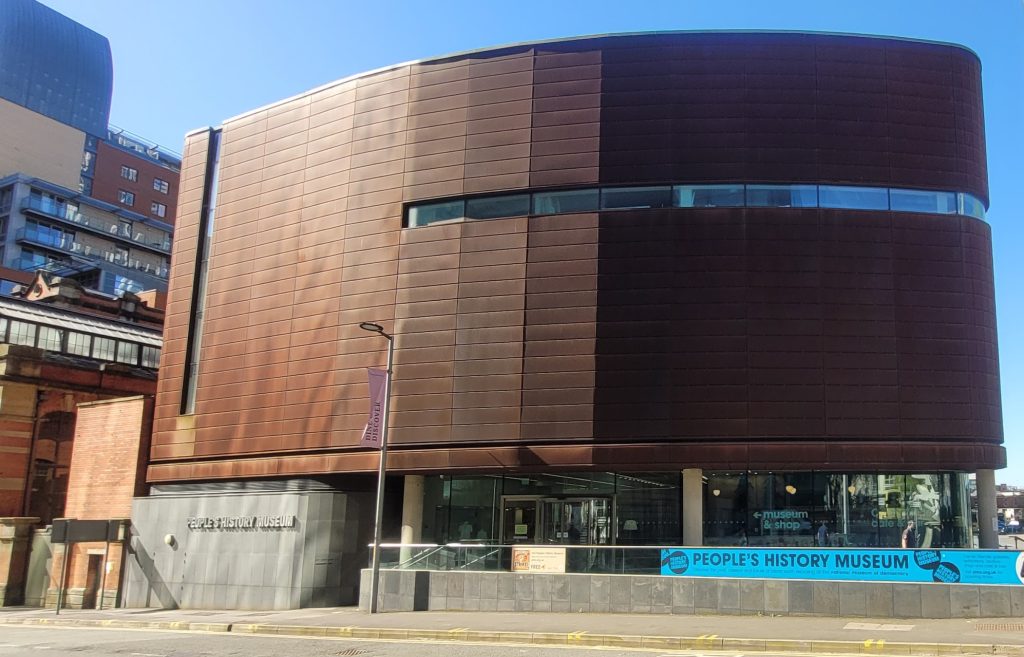
How would you react if your right to vote was stripped from you? Would you care that you no longer had a say in who ran the country you live in? If others like you were also denied the vote, would you take action? These are just a few of the questions that The Peoples History Museum in Manchester tackles. Focusing nearly entirely on the United Kingdom’s history as a democracy, the PHM looks to link historic democratic and suffrage issues with the more modern world, and does so in such a way that the visitor cannot question the legitimacy of the historical and modern comparisons.
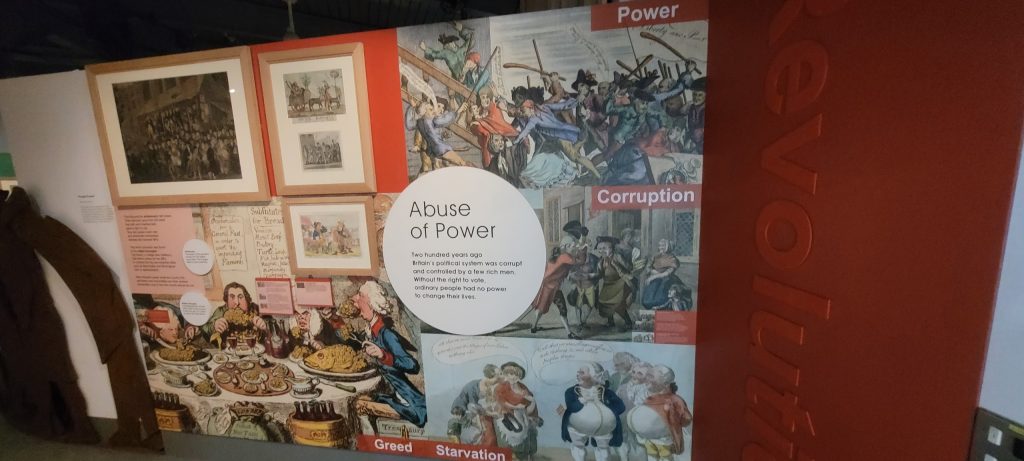
Made up of only two galleries, the PHM is deceptively large. Gallery 1 covers a period of over 200 years of democratic struggle in the UK whereas Gallery 2 though nearly the same size, covers just the last 80 years of history. The above photo is the first piece of museum interpretation any visitor will see and is a great way to introduce the self described ‘national museum of democracy’.1 When visitors look at this wall of interpretation they immediately notice two things, firstly the bubble labelled ‘Abuse of Power’ and secondly, the four prints that surround it marked by the words ‘Power, Corruption, Starvation, and Greed’. This panel sets the tone for Gallery 1 by precisely displaying its upcoming contents. Despite explicitly mentioning the goals of the interpretation, the visitor will become curious as to how and if this ‘Abuse of Power’ was stopped by the people of the past. This is apparent because we all now know that we live in a democracy with certain rights, most obviously the right to vote in elections. Despite the museum not telling us that the people of the past with no rights fought back, we implicitly know it because we know that as citizens of the United Kingdom, we do have the right to vote.
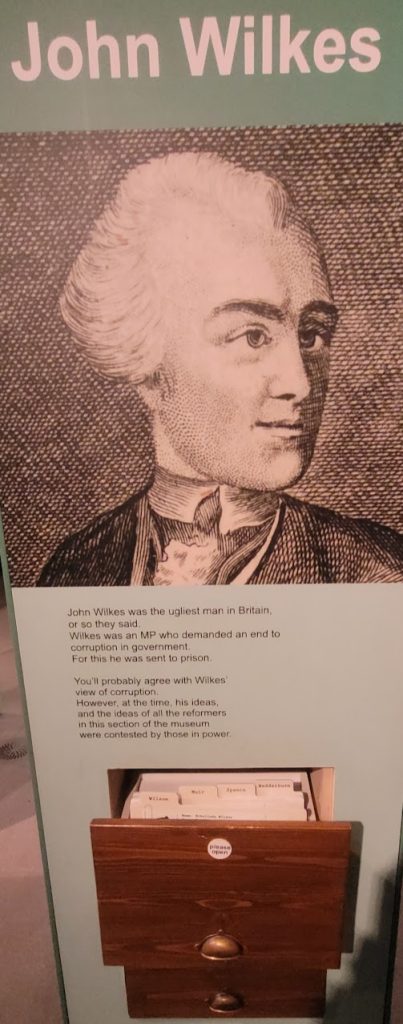
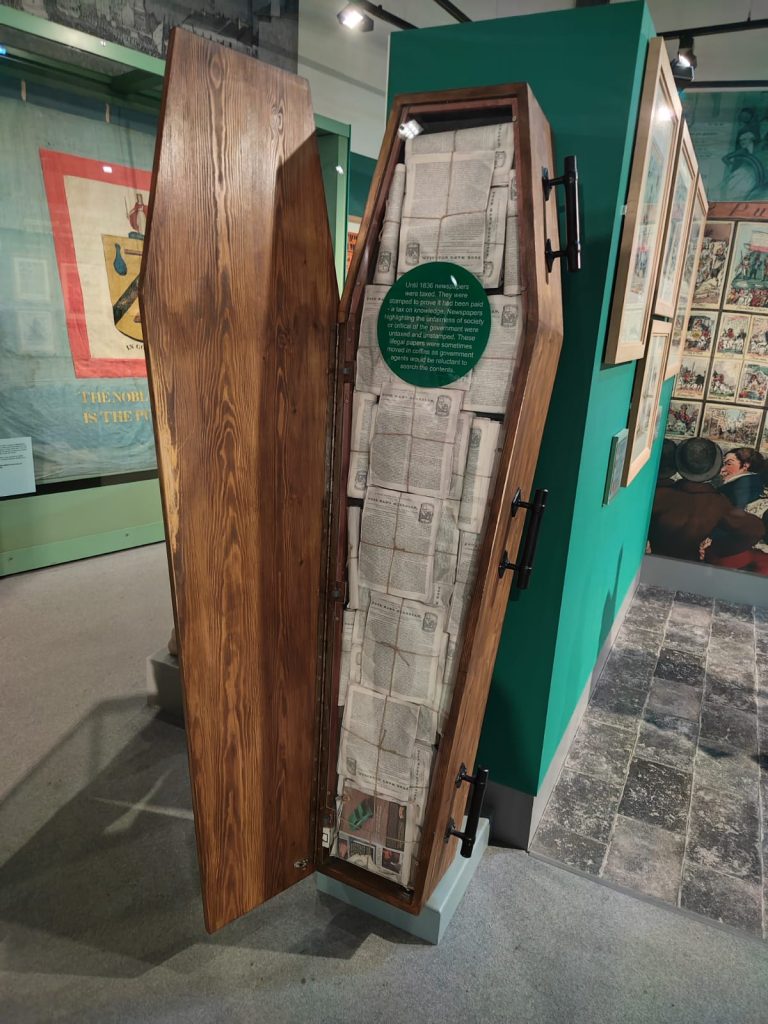
The first section of Gallery 1 focuses on people and events relating to the early struggle against social inequality and injustice. The primary focus is on the the Peterloo massacre, which started as a peaceful protest in favour of democracy and ended in the combined injury and deaths of hundreds of those local to Manchester. The two pieces of interpretation pictured above showcase just how different the past was for even MP’s that dared to challenge the status quo. In just five sentences, the John Wilkes display makes a point that no visitor can disagree with whilst also setting up the rest of the exhibitions inside the museum. Both are shining examples of how short and wildly different methods of interpretation can allow people to immediately understand and relate to the past.
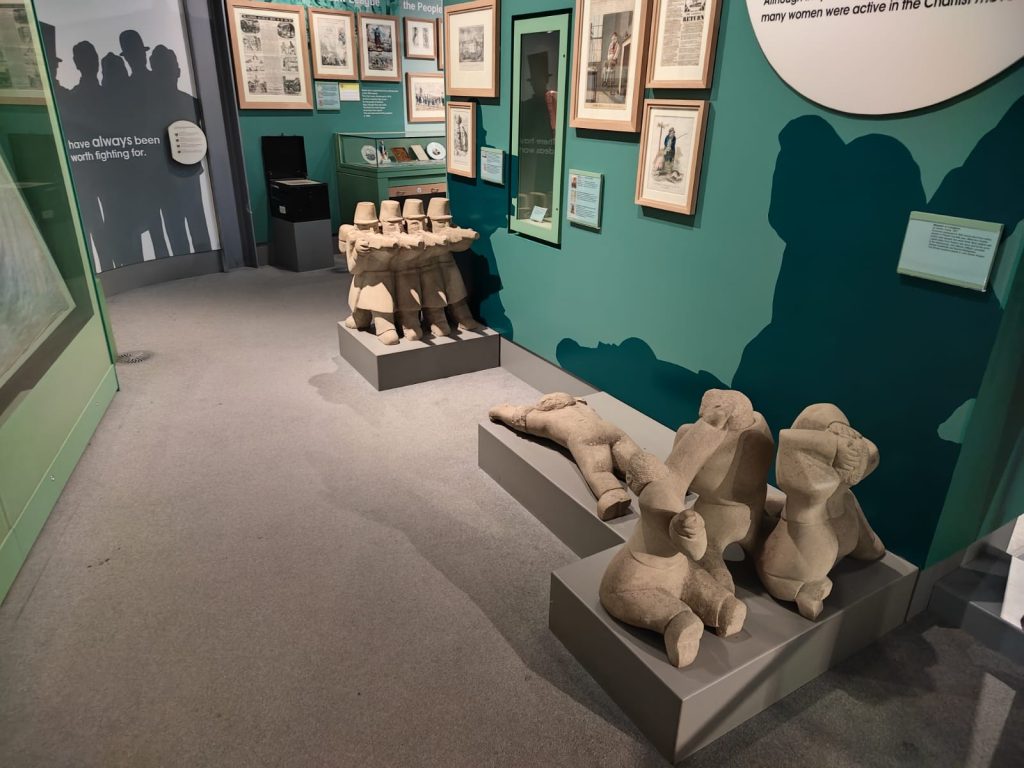
In all good museum exhibitions visitors that stay longer and explore more displays should be rewarded with more interpretation. The PHM takes this idea one step further by including different kinds of interpretation, one example of this can be seen in the picture above. A wall of old prints and artworks are placed above a sculpture of a firing squad. It doesn’t take a wall of words for the visitor to understand the injustice here.
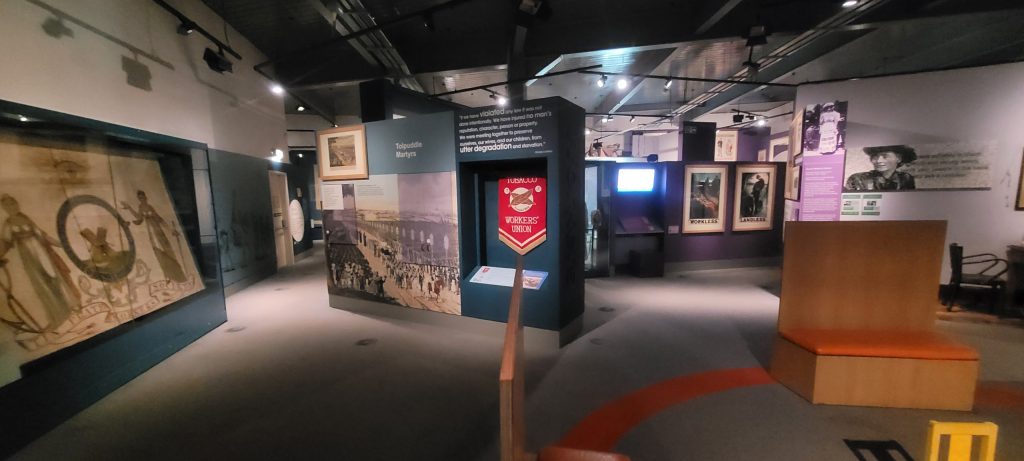
Sometimes freedom for the visitor can be an unnecessary choice. When museums create exhibitions and spaces for visitors to explore, there is a curated message that they want to get you to understand. In order for them to accomplish this, there has to be a general path that the visitor can follow in order for them to correctly and chronologically experience the narrative chosen by the museum. In this regard, the PHM might offer the visitor too much freedom especially considering how much of an open space Gallery 1 is. Personally I always default to following the left hand wall as most others do, but you could see why some visitors might be confused by the choice above.
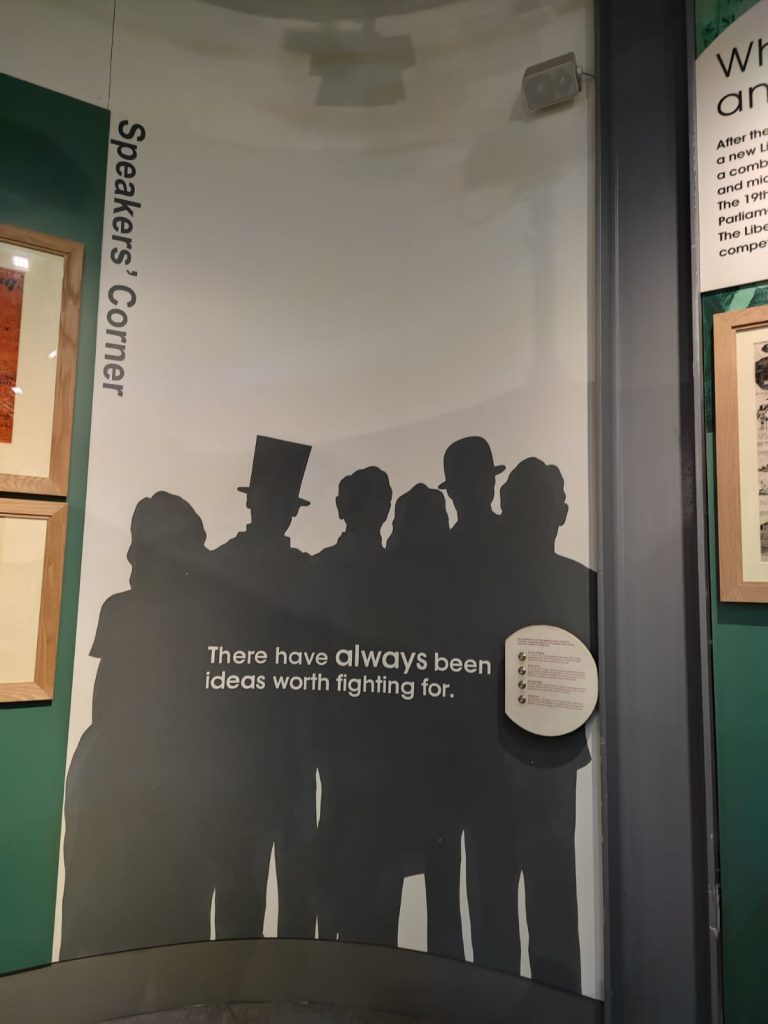
Showcasing a full range of interpretation including written interpretation, artworks, videos, and re-enactments like the one pictured above. I have personally always enjoyed audio-visual interpretation as I feel it can bring you closer to historical events that often written panels cannot. The sound bites pictured above use actors to re-enact speeches of various relatively unknown historical figures. With a little bit of imagination you might be able to see yourself at those rallies!
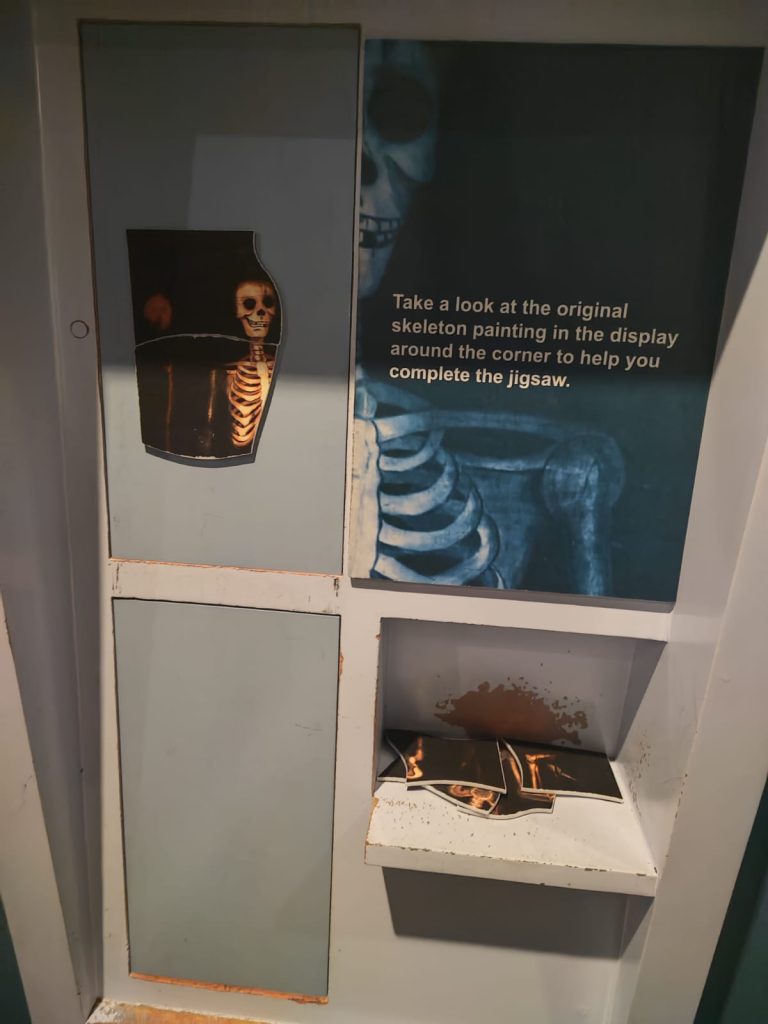
I want to end this look at Gallery 1 by mentioning briefly the interactivity that is present throughout the entire exhibit. Like the above photo, not all of it is interpretation in the sense that it doesn’t uncover any understandings of ideas or topics. However, what Gallery 1 is mainly lacking is an appeal to children and so by adding these bits of interactive interpretation in it allows them to remain somewhat engaged with the exhibition albeit in a limited capacity because the majority of these displays do not link to the bigger picture of social disparity and reform throughout the past,
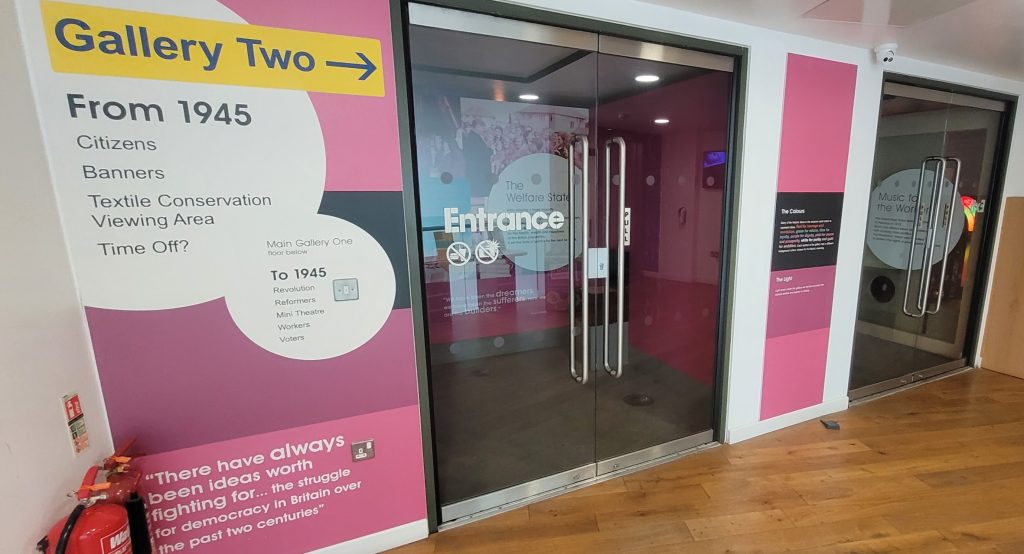
To not spoil the entire museum for anyone wishing to visit, I won’t touch too much on Gallery 2.
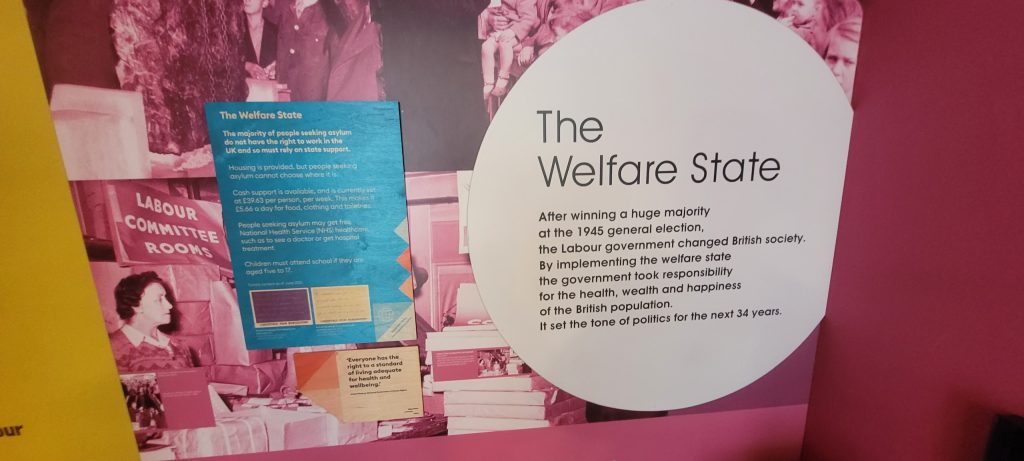
Gallery 2 shows the same introductory panels to the visitor, however rather than focusing on a 200 year period, Gallery 2 with almost the same amount of gallery space spotlights just the last 80 years. This tells all visitors that there will be far more specific interpretive pieces inside. More modern issues are more precisely analysed in gallery 2 compared with Gallery 1. As the picture above also shows, smaller interpretation panels pop up constantly throughout Gallery 2 and offer more angles on social injustices in times that a lot of museum visitors have lived through or that, as a society, we still live through.
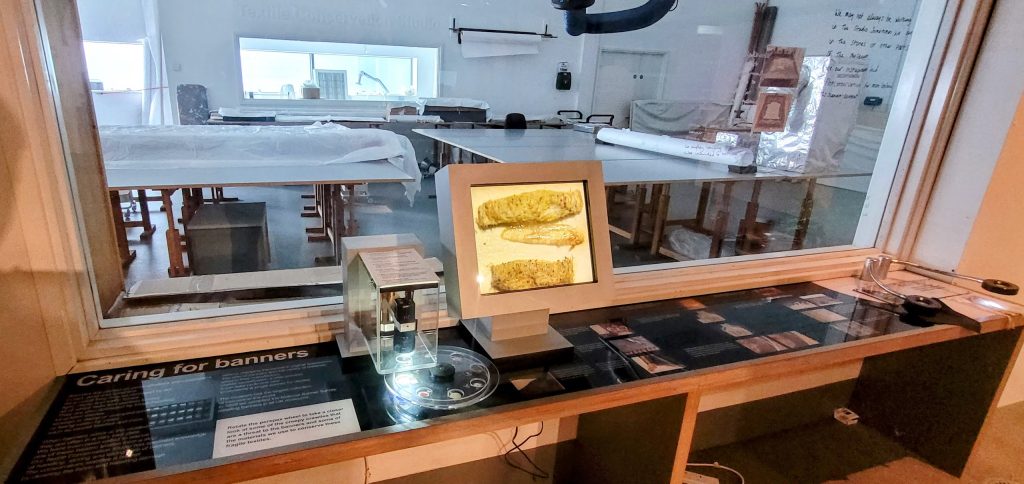
Gallery 2 offers far more interpretive options to explore, the above photo even shows the behind the scenes work that goes into keeping museum objects conserved.
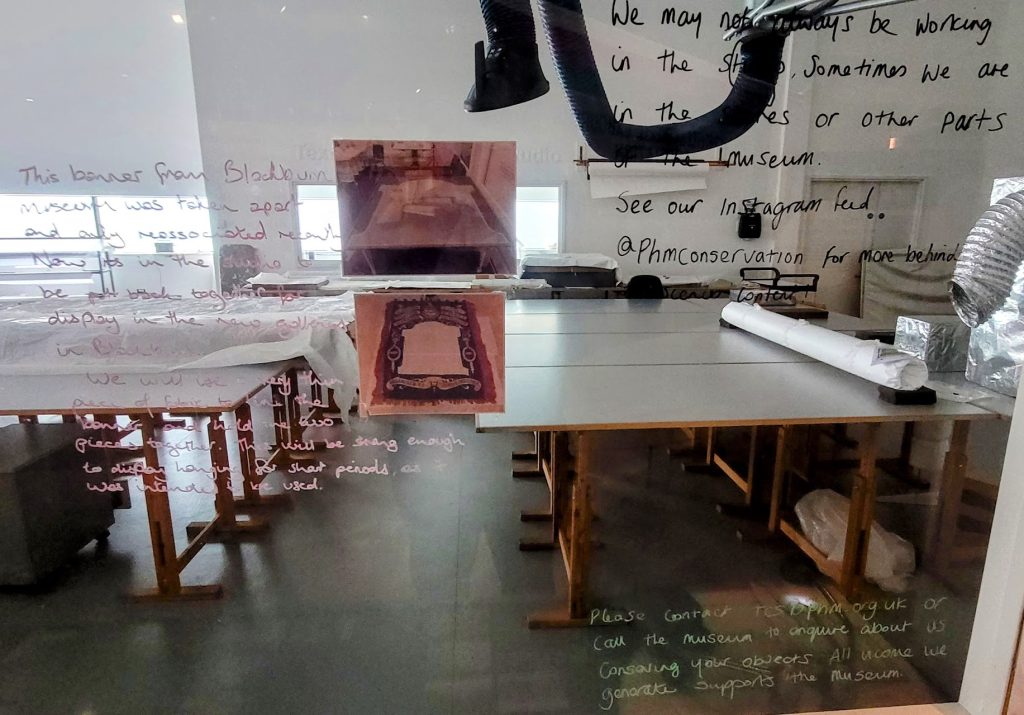
Overall the Peoples History Museum offers a great experience for visitors wishing to explore the social issues of the past and present. It has displays for people of all ages and includes interpretation on local and regional history.
There are a few displays that seem misplaced and some that aren’t quite as engaging as the others, however, the incredible amount of excellent displays on offer at the PHM more than make up for it!
I did not know what to expect when going into this museum, and I certainly did not think I would enjoy it as much as I did, at one point I even spent over 30 minutes sat down listening to and reading up on Jayaben Desai, and I would encourage you all to give this display a go if you visit!
Because of all this and the excellent transport links that Manchester has, I have to give this museum a near perfect 9.6 out of 10! All museums should aspire to produce displays this good. The structure of the museum was clearly well thought out, there are no overlaps in displays and information shown, the displays are thematic, varied, and gripping. I highly recommend visiting this museum, its free but if it wasn’t I would recommend this museum over many others that cost infinitely more to walk around!
Score breakdown (PHM): 14.5/15
https://museum-reviews.jenspot.com/index.php/2025/01/09/the-methodology-behind-my-reviews/
Location 1.5/1.5
Full points have to be awarded to this museum due to the sheer amount of public transport options in Manchester. There are two railway stations within walking distance as well as multiple tram and bus routes.
Accessibility 2.5/3
The museum has great disability access and so has to have the 1.5 points given to it. It drops half a point here due to the lack of specific interpretation aimed towards children, there is a play area and there are certain interactive displays, however the majority of the written interpretation would be hard for children to understand. I even witnessed first hand two children asking their parent what certain words on the panels meant.
Presentation 1/1
Most museums score 1 point here. Whilst the outside of the building is not representative of a traditional museum, there are multiple signs stating that it is one. Furthermore, the inside of the museum is quite classic with a gift shop, cafe and a visitor desk being immediately visible.
Displays 3/3
As mentioned in the review, there are a wide array of different techniques and topics explored in the museums displays. The items on display are shown in unique ways such as the coffin pictured earlier, and some are shown in the traditional cabinet style that most expect when visiting museums. Furthermore, the fact that this museum is so specifically focused on social issues yet manages to display so many different objects relating to this topic solidifies its perfect score.
Interpretation 6/6
The point that the museum is getting across is obvious from the first piece of interpretation to the last. The Interpretation on display is varied, interesting, and unique to the PHM. There is no way it could score less than full here. The majority of the interpretation at the PHM is of excellent quality and it has clearly been well thought out.
Amenities 0.5/0.5
“I love a little shop”

Leave a Reply